Australia sees 1 GW of solar capacity reach FID in Q3

Following a record 5 GW of large-scale renewable energy investment to the end of Q3 2026, up from 4.9 GW in 2025, the Clean Energy Regulator (CER) has raised the lower bound of its 2026-2027 final investment decision (FID) projection from 6 GW-8 GW, to 8 GW-16 GW.
“In the Q4 2025 Quarterly Carbon Market Report (QCMR), we projected that between 6 and 16 GW of large-scale renewable generation capacity would reach FID over 2026 and 2027. The record level of investment activity observed during 2026 has significantly reduced downside risks to this outlook,” the Q3 2026 QCMR report says.
Of the nine projects to reach FID in Q3 2026 totalling 2.1 GW, five received support under the Capacity Investment Scheme (CIS) including two solar projects in Queensland, the 150 MW Ganymirra Solar Power Station and 150 MW Majors Creek Solar Farm.
It was the fourth-strongest quarter for solar with 1 GW of capacity reaching FID. By mid-November 2026 all investments moved year-to-date FID to 5.5 GW.
“Solar accounted for 3.5 GW of FID in 2026 to date,” the report says. “Australian Renewable Energy Agency’s (ARENA) update to their Ultra Low-cost Solar white paper identified a range of opportunities to reduce the cost of deploying utility-scale solar in Australia, which could continue to strengthen the investment case for both standalone solar and hybrid solar-and-storage projects.”
The report also says the ARENA paper highlights improved cell and module efficiency, innovation in construction and deployment models, including automation, prefabrication, modular delivery, and digital and data-driven operational and maintenance optimisation as potential pathways to lower project costs.
Battery pipeline
The CER’s new large-scale battery pipeline tracker recorded 3.4 GW and 13.8 GWh of storage capacity reaching FID in Q3, taking the 2026 total to date to 5.1 GW and 20 GWh, where average capacity more than doubled from 265 MWh in 2025 to 621 MWh in the year so far.
Projects to reach FID included the 2,200 MWh Richmond Valley Solar Farm BESS in New South Wales (NSW), and the 1,860 MWh Baranduda Electrical Energy Reserve and 1,200 MWh Moorabool Battery, both in Victoria.
In Queensland, the 1,215 MWh Stage 3 South Pine Supernode BESS and 800 MWh Koolunga BESS, supported by the CIS, in South Australia (SA).
The QCMR cites the Australian Electricity Market Operator (AEMO) as reporting that average large-scale battery discharge also more than tripled year-on-year and that large-scale batteries set prices in a record 48% of National Electricity Market (NEM) dispatch intervals.
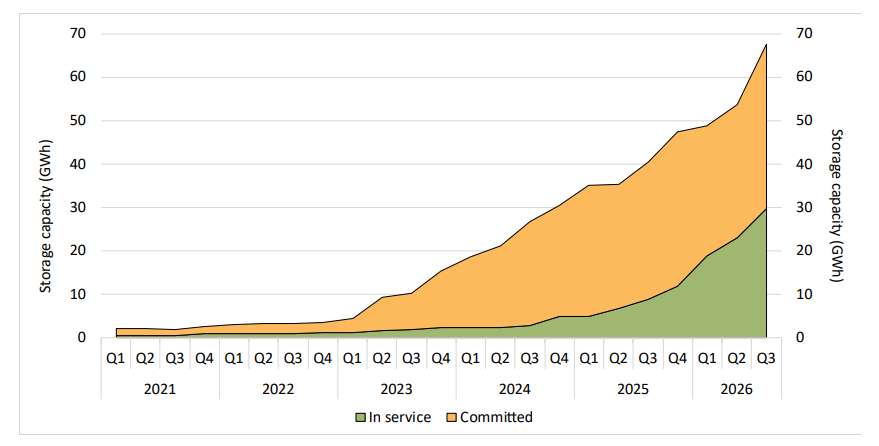
The increased battery charging and changing demand patterns were also attributed to few negative-price intervals and allowed more available large-scale solar generation to be used.
“The share of available solar generation reduced by solar farms in response to low prices (economic offloading) fell by 54% year-on-year while batteries supplied more evening peak generation (8%) than gas (1.5%) for the first time in any quarter,” the report says.
The CER says approvals of renewable generation projects under the Large-scale renewable energy target (LRET) was “subdued”, which it said is expected to lag the recent uplift in investment.
“A total of 0.6 GW was approved in Q3, bringing approvals to 2.1 GW for the year-to-date. With 570 MW under assessment as 30 September, we have revised our 2026 approvals from project from 3.5 to 4.5 GW to 2.6 to 3.4 GW,” the report says.