These cranberry bogs come with a side of solar
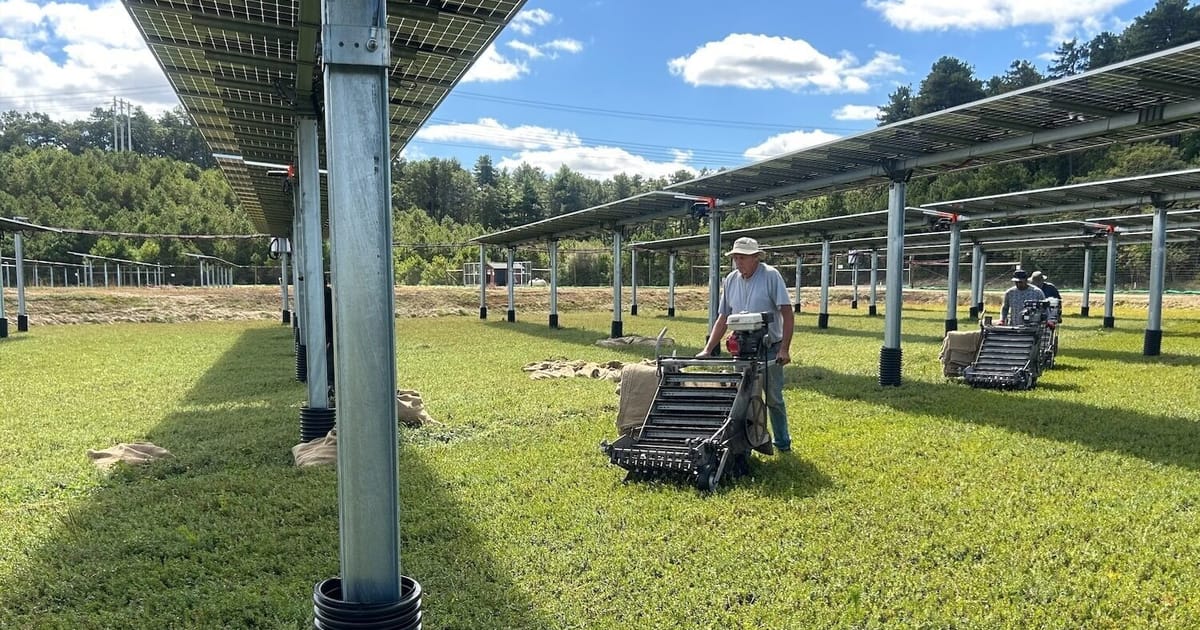
It’s cranberry season in southeastern Massachusetts. At bogs throughout the region, growers are collecting the ruby-red berries destined for holiday cakes, juice bottles, and cans of jellied sauce. At two farms, however, the harvesting process looks a little different: Pickers are navigating equipment around metal poles in the shade of solar panels.
The two bogs are the first in the country — perhaps the world — to grow cranberries beneath an operating solar installation. This fall marks the second season cranberries have been harvested from beneath the panels.
“We are literally proving it can be done,” said Prateek Tare, co-founder and executive vice president of Distributed Energy Infrastructure. His company constructed the two projects — a 4.4-megawatt array paired with a 13.5-megawatt-hour battery in the town of Kingston, and a 1-MW solar array in neighboring Plymouth.
Solar development is a major part of Massachusetts’ plan to reach net-zero carbon emissions by 2050. The state has offered solar incentives since 2001, evolving and expanding them over the decades to drive even more development.
However, the question of where to site solar projects has become a major point of contention in the densely populated and heavily wooded state. Building on rooftops and parking lots in developed areas can increase costs and limit generation capacity. But proposals for arrays on previously undeveloped land often spark protests from locals worried about the character of their community and environmental groups opposed to disrupting ecosystems. Using pre-cleared farmland has potential, but raises concerns about taking agricultural acres out of production. Many of these same dynamics are at play in communities across the U.S.
One of the solutions Massachusetts has been encouraging is agrivoltaics, or dual-use solar, which involves building solar panels above active agricultural operations. This strategy, which is gaining traction nationwide, allows farmland to be used for energy generation even as livestock graze or crops flourish beneath the elevated arrays.
In 2018, Massachusetts became the first state to offer a financial boost to dual-use solar projects like these. The state’s solar incentive program pays participants a set rate for every kilowatt-hour of electricity they generate; an array with a capacity between 1 MW and 5 MW currently gets a base rate of 23.17 cents. Agrivoltaic projects get an extra 9 cents per kilowatt-hour.
That can be enough money to attract developers interested in leasing land for solar arrays or, less commonly, buying property outright with an agreement to keep it in agricultural use. Farmers who agree to lease are also generally paid for their services maintaining the landscape around the panels and poles.
In Kingston and Plymouth, clean energy developer Greenbacker Renewables bought the land, which had been home to cranberry-growing operations for decades, from farmers who were ready to get out of the business. Greenbacker then worked with Distributed Energy Infrastructure to build the arrays, and hired Iain Ward, a solar consultant and longtime cranberry farmer in the area, to manage the growing operations. Both projects use a community solar model, selling power to customers interested in the lower prices and environmental benefits offered by renewable energy.