
Robotic Hand Aims To Make Gripping Objects Easier
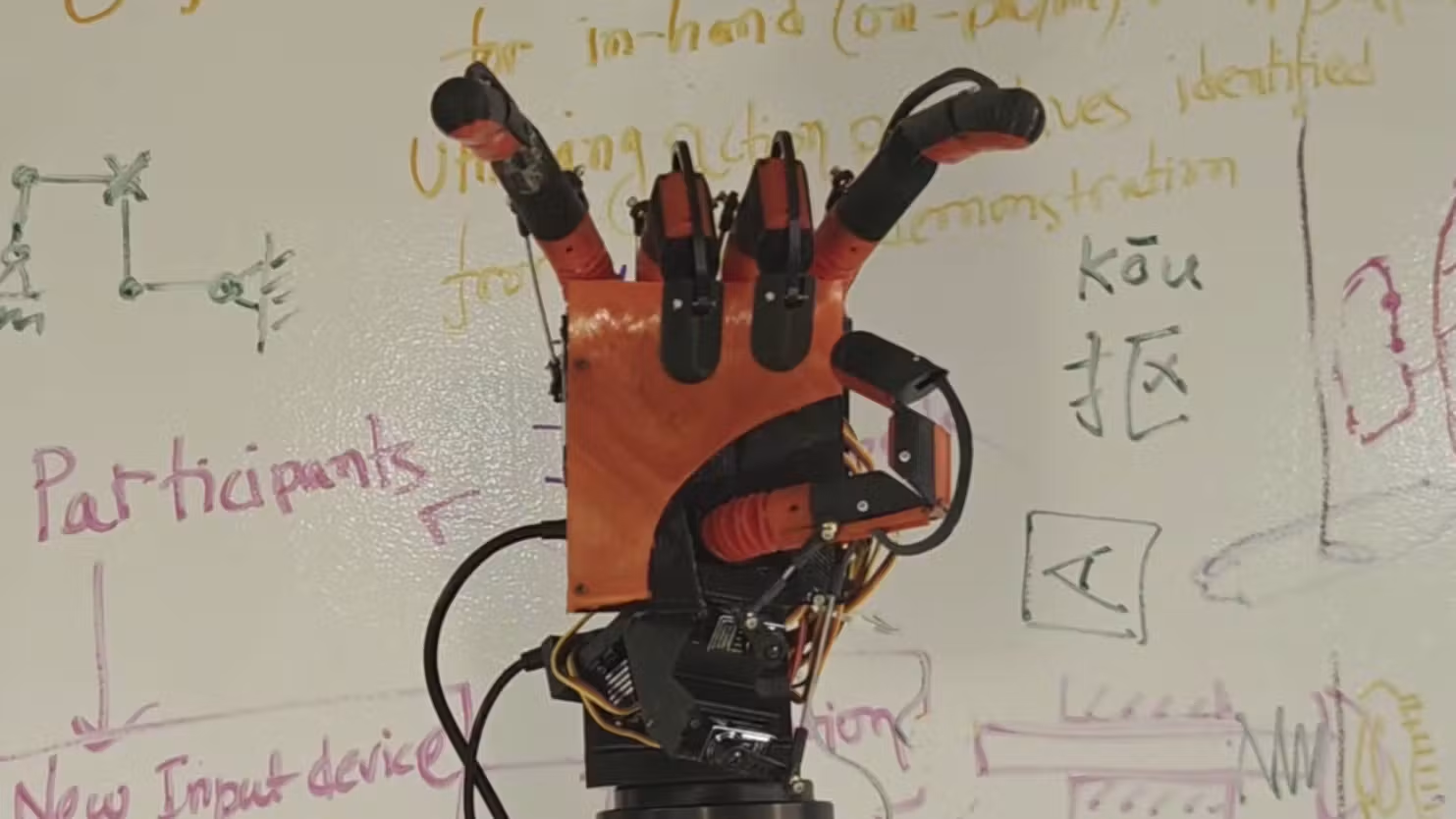
The robotic hand uses 3D-printed parts, small motors and flexible rods to copy human finger movements.
Researchers from the New Jersey Institute of Technology in Newark and Union County Magnet High School in Scotch Plains, USA, have developed PHD-Hand, a low-cost, 3D-printable robotic hand. Instead of relying on complicated mechanical arrangements, the PHD-Hand can be built using a basic 3D printer to manufacture its structural parts, hobby servos and other commercially available hardware components. The main idea is to make dexterous robotic hands easier and potentially less expensive to build.
The PHD-Hand was inspired by the flexible strain relief structures found on electrical cable connectors. The researchers have 3D-printed a similar flexible hinge at the base of each finger. This hinge allows the finger to tilt in two directions while resisting axial rotation. A flexible stainless steel spring rod, measuring just 0.6 mm in thickness, runs through the centre of the hinge. Its purpose is to transmit movement to the other two joints of the finger.
Each finger (digit) uses three miniature RC hobby servos. The finger has a base joint, a middle joint and an upper joint. The scientists apply two varieties of rods for controlling these joints. Two rigid drive rods operate the base joint. Due to being rigid, these rods transfer motion from the servos to the joint without any deformation. One flexible steel rod controls the middle and upper joints. As was stated above, this rod passes through the flexible hinge and transfers motion to other joints.
When the human finger bends, its middle and upper joints bend in a unified way. PHD-Hand applies such a scheme too. The researchers say that each digit requires as few as 13 major mechanical parts, excluding motors (actuators) and sensors. In contrast to this, however, some of the competing robotic hands have as many as 27 or even more mechanical components per finger.
These scientists relied on the assistance of an AI program that helped them develop software that enables them to control the movements of the robotic hand via the computer. This software is able to interact with a Pololu Mini Maestro 18 servo controller, which is an electronic device controlling up to 18 servo motors.
In 200 hours of testing, the prototype had only two mechanical failures. Both involved broken spring steel drive rods. The researchers plan to further refine the mechanical design and prepare it for an open-source release.


