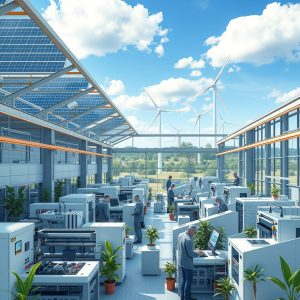
The Green Circuitry: How Resource-Efficient Production and Bio-Based Tech Materials Are Redefining Sustainable Manufacturing
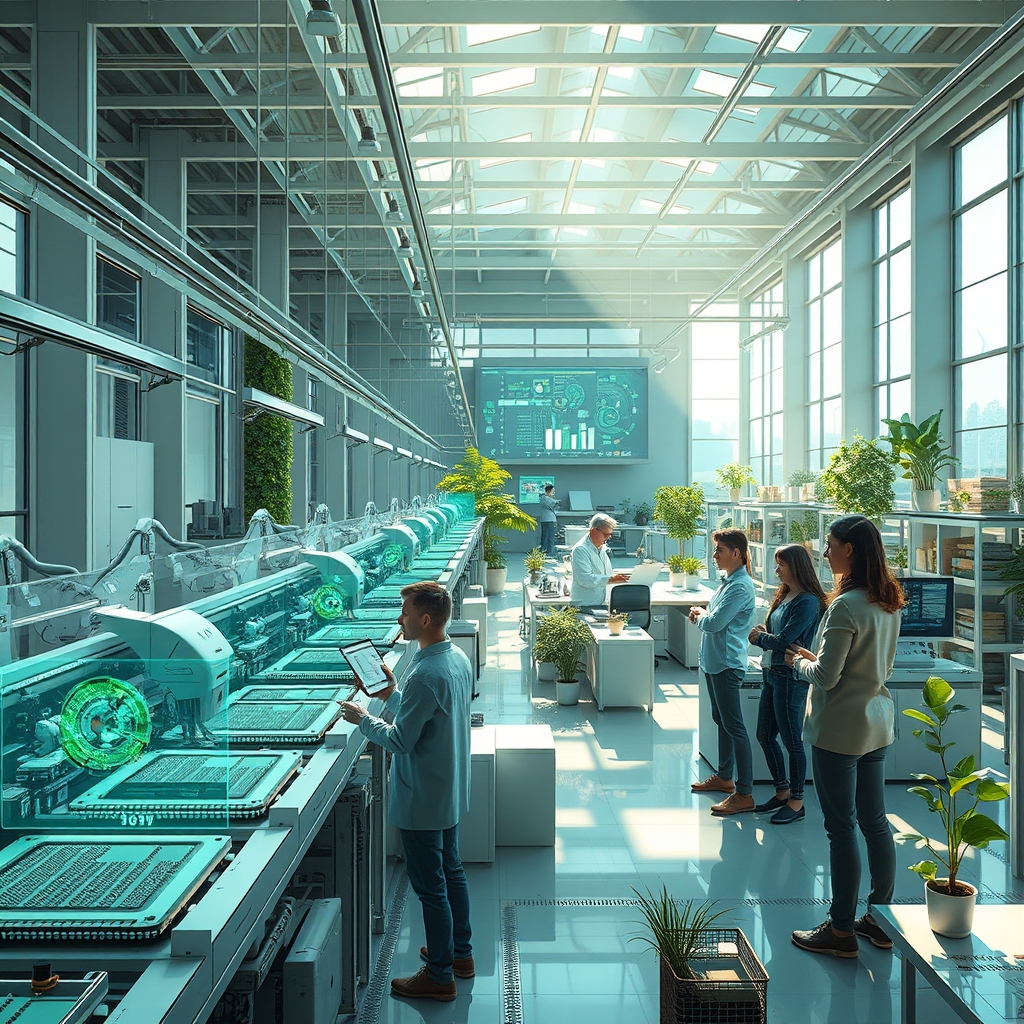
The hum of machinery in a modern tech manufacturing plant is no longer just a symphony of productivity; it is increasingly a testament to a deeper harmony—one where efficiency meets ecology. The shift toward sustainable tech manufacturing is not merely a trend but a fundamental reimagining of how electronics are conceived, produced, and brought to life. At the heart of this transformation lies the dual pillars of resource-efficient production and bio-based tech materials, two forces that are quietly rewiring the industry’s DNA.
The Alchemy of Efficiency: Rethinking Resource Use
For decades, the tech industry operated under a linear model: extract, produce, discard. This approach, while profitable, left behind a trail of ecological debt—depleted resources, overflowing landfills, and a carbon footprint as vast as the digital landscapes it powered. Today, however, a new paradigm is emerging, one where every watt of energy, every gram of material, and every drop of water is scrutinized for its potential to be optimized, reused, or eliminated entirely.
Resource-efficient production is not about doing less; it’s about doing more with less. Advanced analytics and AI-driven systems now monitor production lines in real time, identifying inefficiencies with surgical precision. For instance, predictive maintenance algorithms anticipate equipment failures before they occur, reducing downtime and energy waste. Meanwhile, additive manufacturing—commonly known as 3D printing—allows for the creation of components with minimal material input, often using only what is necessary to achieve structural integrity. The result? A dramatic reduction in raw material consumption and a corresponding drop in waste.
But efficiency isn’t just about the machines; it’s also about the mindset. Companies are increasingly adopting lean manufacturing principles, where every process is stripped down to its essentials, eliminating redundancies and streamlining workflows. This approach doesn’t just cut costs—it cuts emissions, energy use, and environmental impact, all while maintaining, or even improving, product quality.
The Rise of Bio-Based Materials: Nature as the Ultimate Innovator
If resource-efficient production is the engine of sustainable tech manufacturing, then bio-based materials are the fuel. For too long, the electronics industry has relied on petroleum-derived plastics, rare earth metals, and other finite resources that come with a heavy environmental toll. Now, researchers and engineers are turning to nature for inspiration, developing materials that are not only sustainable but often superior in performance.
Take, for example, the emergence of bioplastics derived from algae, cornstarch, or even agricultural waste. These materials are not only biodegradable but can also be engineered to possess properties that rival traditional plastics—durability, flexibility, and heat resistance. In the realm of circuit boards, scientists are experimenting with mycelium—the root structure of fungi—as a substrate, creating a material that is lightweight, compostable, and capable of replacing conventional fiberglass-based boards.
Then there are the breakthroughs in bio-based semiconductors, where organic compounds are used to create transistors and other electronic components. These materials, often derived from plant-based sources, offer the potential for lower energy consumption during production and easier recyclability at the end of their lifecycle. The implications are profound: imagine a smartphone whose components could, at the end of its life, be returned to the earth without leaving a trace of toxic waste.
The Synergy of Efficiency and Innovation
The true power of this shift lies in the synergy between resource-efficient production and bio-based materials. When combined, these approaches create a virtuous cycle: less waste in production means fewer resources are needed, and bio-based materials often require less energy to produce and process. This, in turn, reduces the overall carbon footprint of the manufacturing process, creating a feedback loop that continually drives sustainability forward.
Consider the case of a leading electronics manufacturer that recently overhauled its production line to incorporate both strategies. By switching to bio-based plastics for its product casings and implementing AI-driven energy optimization, the company reduced its material waste by 40% and its energy consumption by 25%. The result was not just a greener product but a more cost-effective one, proving that sustainability and profitability are not mutually exclusive.
The Human Element: Cultivating a Culture of Conscious Innovation
Yet, for all the technological advancements, the most critical component of this transformation is the human element. Sustainable tech manufacturing is not just about the tools and materials; it’s about the people who wield them. Engineers, designers, and factory workers must be empowered to think differently, to see waste not as an inevitable byproduct but as a failure of design. This cultural shift is perhaps the most challenging aspect of the transition, but it is also the most rewarding.
Companies are beginning to invest in training programs that teach employees about circular design principles, where products are designed from the outset to be disassembled, reused, or recycled. Workshops on life cycle assessment help teams understand the environmental impact of their decisions at every stage of a product’s life, from raw material extraction to end-of-life disposal. And perhaps most importantly, there is a growing emphasis on transparency, with companies sharing their sustainability metrics openly, inviting scrutiny, and fostering a culture of continuous improvement.
The Road Ahead: Challenges and Opportunities
Of course, the path to fully sustainable tech manufacturing is not without its obstacles. Bio-based materials, while promising, are still in the early stages of commercialization, and scaling them up to meet global demand presents significant challenges. Similarly, resource-efficient production requires upfront investment in new technologies and infrastructure, which can be a barrier for smaller manufacturers. And then there is the issue of consumer behavior—will the market embrace products that may come with a higher price tag, even if they offer long-term environmental benefits?
Yet, these challenges are not insurmountable. Governments and industry consortia are increasingly collaborating to create incentives for sustainable practices, from tax breaks for companies that adopt green manufacturing to subsidies for research into bio-based materials. Meanwhile, consumers are becoming more conscious of their purchasing decisions, demanding transparency and sustainability from the brands they support. This growing awareness is creating a powerful feedback loop, where market demand drives innovation, and innovation, in turn, fuels further demand.
The factories of the future will not be dark, smoky fortresses of industry but bright, clean spaces where technology and nature coexist. They will be places where every process is optimized not just for speed or cost, but for the health of the planet and its people. The shift is already underway, and while the journey is far from over, the destination—a world where technology is not just sustainable but regenerative—is within reach. The question is no longer whether this transformation will happen, but how quickly we can accelerate it, and how deeply we can embed these principles into the very fabric of innovation.