The Unwritten Code: How Sustainable Tech Manufacturing is Rewriting the Rules of Innovation
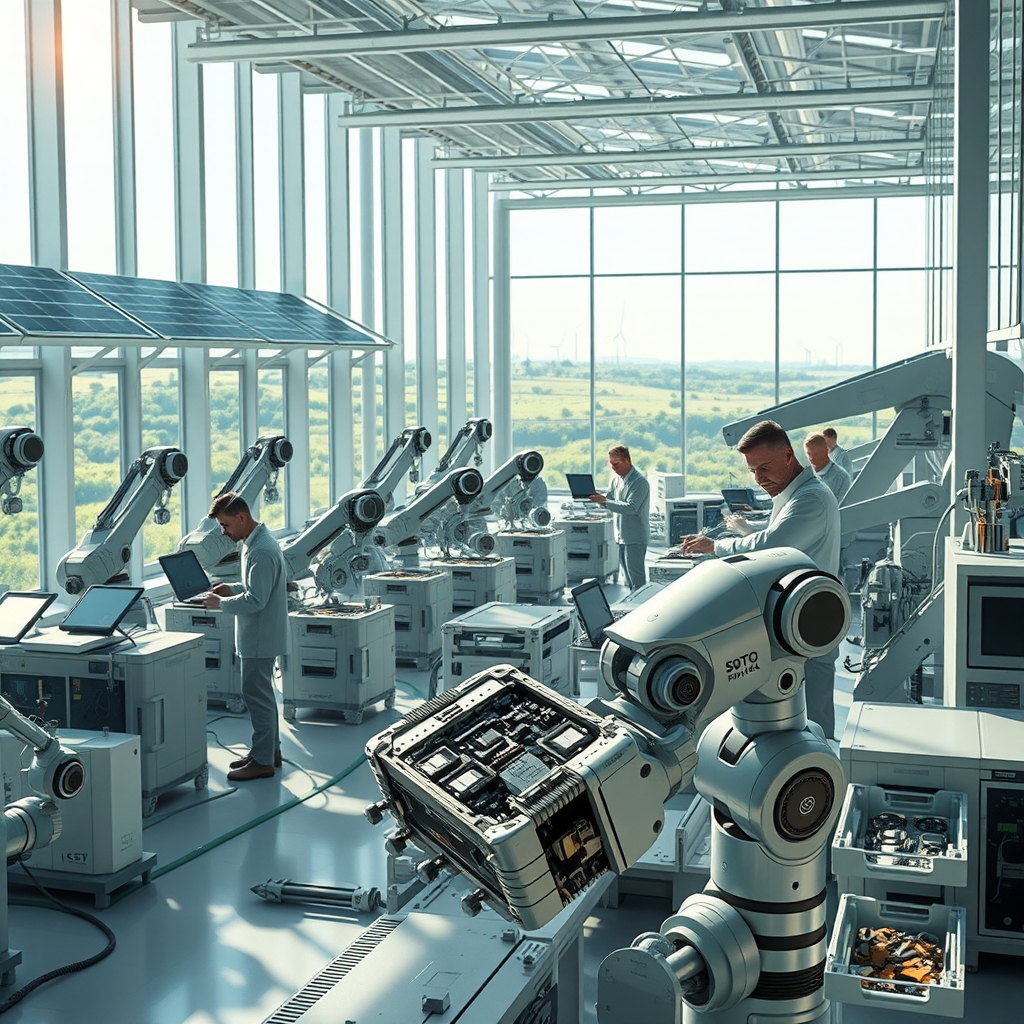
The factory floor hums with a quiet efficiency, a stark contrast to the clamor of traditional manufacturing. Here, machines do not roar; they whisper, their movements precise and deliberate, as if guided by an unseen hand of sustainability. This is the realm of sustainable tech manufacturing, where every component, every process, and every decision is infused with an unwritten code—one that prioritizes the planet as much as profit. It is a world where innovation is not measured solely by speed or scale, but by the depth of its ecological footprint and the longevity of its impact.
The Alchemy of Circular Design
At the heart of this transformation lies circular design, a philosophy that challenges the linear “take-make-waste” model of production. Imagine a smartphone designed not just for today’s trends, but for tomorrow’s possibilities. Its components are modular, easily disassembled, and infinitely recyclable. The materials—bio-based polymers, reclaimed metals, and conflict-free minerals—are chosen not just for their performance, but for their ability to re-enter the production cycle without degradation. This is the alchemy of circular design: turning waste into worth, obsolescence into opportunity.
Companies like Fairphone and Framework have embraced this ethos, crafting devices that are as repairable as they are revolutionary. Their products are not just tools; they are statements, proving that durability and sustainability can coexist without compromise. The result? A reduction in e-waste, a conservation of resources, and a shift in consumer expectations—one where longevity is celebrated over disposability.
The Green Pulse of Renewable Energy
But circular design is only one piece of the puzzle. The factories that bring these products to life must also operate within the bounds of sustainability. Enter renewable energy integration, the lifeblood of green electronics production. Solar panels stretch across rooftops like a second skin, while wind turbines stand sentinel in the distance, their blades slicing through the air with rhythmic precision. Inside, energy-optimized fabrication processes ensure that every kilowatt-hour is used with intention, minimizing waste and maximizing efficiency.
Take, for example, the Tesla Gigafactory in Nevada, a facility powered entirely by renewable energy. Its operations are a testament to what happens when ambition meets innovation. By harnessing solar, wind, and geothermal energy, the factory doesn’t just reduce its carbon footprint—it erases it. This is not just manufacturing; it is a revolution in how we power progress.
The Ethics of Material Sourcing
Yet, even the most energy-efficient factory cannot claim sustainability if the materials it uses are tainted by exploitation. Ethical material sourcing is the foundation upon which green electronics are built. Cobalt from the Democratic Republic of Congo, lithium from the salt flats of Chile, and rare earth metals from China—these resources have long been associated with environmental degradation and human rights abuses. But a new wave of conscious innovation is changing the narrative.
Companies are now turning to blockchain technology to trace the journey of raw materials, ensuring transparency at every step. Initiatives like the Responsible Minerals Initiative and Fair Cobalt Alliance are working to eliminate child labor and improve working conditions in mining communities. Meanwhile, researchers are exploring alternatives to traditional materials, such as graphene for batteries and mycelium for packaging, reducing reliance on finite resources. This is not just about sourcing responsibly; it is about redefining what it means to build ethically in the 21st century.
The Closed Loop Promise
Sustainable tech manufacturing is not a destination; it is a continuous loop of improvement. Closed loop manufacturing takes this idea to its logical conclusion, creating systems where waste is not just minimized but eliminated entirely. Picture a laptop returned to its manufacturer at the end of its life. Instead of ending up in a landfill, it is dismantled, its components sorted, and its materials repurposed into new devices. This is the promise of closed loop manufacturing: a world where nothing is discarded, and everything is reborn.
Apple’s recycling robot, Daisy, is a prime example of this philosophy in action. Daisy can disassemble 200 iPhones per hour, recovering valuable materials like gold, cobalt, and rare earth elements. These materials are then reintegrated into the production process, reducing the need for virgin resources. It is a small step, but one that signals a seismic shift in how we think about consumption and waste.
The Minimalist Manifesto
In a world obsessed with more—more features, more power, more speed—minimalist tech design offers a counterpoint. It is a manifesto that declares less can indeed be more, especially when it comes to sustainability. By stripping away the unnecessary, designers can create products that are not only elegant but also environmentally responsible. Fewer materials mean less waste. Simpler designs mean easier recycling. And a focus on longevity means fewer devices ending up in landfills.
Consider the rise of modular electronics, where users can upgrade individual components rather than replacing entire devices. Or the growing popularity of “right to repair” laws, which empower consumers to fix their own gadgets rather than discarding them. These trends are not just about saving money; they are about saving the planet. Minimalist tech design is a reminder that sometimes, the most revolutionary ideas are the simplest ones.
The Future, Written in Green
The journey toward sustainable tech manufacturing is not without its challenges. It requires rethinking entrenched systems, challenging industry norms, and investing in long-term solutions over short-term gains. But the rewards—cleaner air, healthier ecosystems, and a more equitable world—are worth the effort. As more companies embrace circular design, renewable energy, ethical sourcing, and closed loop systems, the unwritten code of sustainability becomes clearer. It is not just about building better products; it is about building a better future. And in that future, the hum of the factory floor is not just a sound—it is a symphony of progress, played in harmony with the planet.