The Breath of Innovation: How Climate-Positive Manufacturing is Redefining Sustainable Tech

In the heart of a bustling tech hub, where the hum of machinery once echoed with the relentless pursuit of progress, a new rhythm is emerging—one that harmonizes innovation with the very air we breathe. The shift toward climate-positive manufacturing is not just a trend; it is a profound transformation, a reimagining of how technology is conceived, crafted, and consumed. Here, the goal is no longer merely to reduce harm but to actively restore, to leave the planet in a better state than we found it. This is the essence of a movement that is quietly reshaping the future of sustainable tech.
The Philosophy of Climate-Positive Manufacturing
Climate-positive manufacturing transcends the traditional boundaries of sustainability. While net-zero initiatives aim to balance emissions with offsets, climate-positive approaches go further, striving to sequester more carbon than is emitted throughout a product’s lifecycle. This philosophy is rooted in a deep understanding of interconnected systems, where every stage of production—from material sourcing to end-of-life disposal—is an opportunity to heal rather than harm. It is a bold departure from the linear models of the past, where waste was an afterthought and resources were treated as infinite.
At its core, climate-positive manufacturing is about regeneration. It asks not just how we can minimize our footprint but how we can actively contribute to the restoration of ecosystems. This might involve integrating carbon-capturing materials into product designs, such as bio-based polymers derived from algae or agricultural waste, which absorb CO2 as they grow. It could mean adopting closed-loop systems where waste from one process becomes the raw material for another, creating a symbiotic relationship between technology and nature. The result is a manufacturing paradigm that doesn’t just sustain but revitalizes.
The Role of Renewable Energy Integration
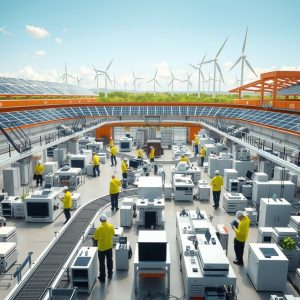
Energy lies at the heart of climate-positive manufacturing. The transition from fossil fuels to renewable sources is not just a logistical shift but a cultural one, demanding a rethinking of how energy is generated, stored, and utilized. Solar arrays stretch across factory rooftops like vast, shimmering canopies, while wind turbines stand sentinel in nearby fields, their blades slicing through the air with quiet determination. But the integration of renewables goes beyond mere installation; it requires a holistic approach to energy management, where smart grids and AI-driven systems optimize consumption in real time.
One of the most exciting developments in this space is the rise of microgrids—localized energy networks that can operate independently or in conjunction with the main grid. These systems allow manufacturers to harness renewable energy more efficiently, reducing reliance on centralized power sources and minimizing transmission losses. Paired with advanced battery storage solutions, such as solid-state or sodium-ion batteries, microgrids ensure that energy is available when and where it’s needed, even when the sun isn’t shining or the wind isn’t blowing. This level of energy autonomy is not just a technical achievement; it is a testament to the resilience of climate-positive manufacturing.
Ethical Material Sourcing: The Foundation of Climate-Positive Tech
The journey toward climate positivity begins long before a product reaches the assembly line. It starts with the materials themselves—where they come from, how they are extracted, and the ethical implications of their sourcing. Traditional mining and manufacturing processes are often fraught with environmental degradation and human rights concerns, but climate-positive manufacturing demands a different approach. Ethical material sourcing prioritizes transparency, traceability, and sustainability, ensuring that every component is harvested or produced in a way that aligns with regenerative principles.
Take, for example, the growing use of recycled metals in electronics. By reclaiming materials from discarded devices, manufacturers can drastically reduce the need for virgin mining, which is notoriously energy-intensive and environmentally destructive. Similarly, bio-based alternatives to plastics, such as mycelium or hemp composites, offer a renewable and biodegradable option that doesn’t sacrifice performance. These materials are not just substitutes; they are innovations in their own right, designed to work in harmony with the planet rather than against it.
Low-Carbon Prototyping: Designing for a Lighter Footprint
Prototyping is a critical phase in product development, but it is also one of the most resource-intensive. Traditional prototyping methods often involve multiple iterations, each requiring new materials, energy, and time. Climate-positive manufacturing challenges this status quo by embracing low-carbon prototyping techniques that minimize waste and maximize efficiency. Digital twins, for instance, allow engineers to simulate and refine designs in a virtual environment before a single physical prototype is created. This not only reduces material waste but also accelerates the development process, enabling faster iterations and more innovative solutions.
Additive manufacturing, or 3D printing, is another game-changer in low-carbon prototyping. By building components layer by layer, this technology eliminates much of the waste associated with subtractive manufacturing methods, where excess material is cut away and discarded. Moreover, 3D printing enables the use of recycled or bio-based filaments, further reducing the environmental impact of prototyping. When combined with modular design principles, where products are built from interchangeable components, additive manufacturing paves the way for a future where tech is not just sustainable but infinitely adaptable.
The Path Forward: A Vision of Regenerative Tech
The shift toward climate-positive manufacturing is not without its challenges. It requires significant investment, cross-industry collaboration, and a willingness to rethink long-established practices. Yet, the rewards are immense—not just for the planet but for the businesses that embrace this vision. Companies that adopt climate-positive strategies are finding that sustainability and profitability are not mutually exclusive; in fact, they are deeply intertwined. Consumers are increasingly drawn to brands that align with their values, and investors are prioritizing companies with strong environmental, social, and governance (ESG) credentials.
As we stand on the precipice of a new era in tech manufacturing, the question is no longer whether we can afford to pursue climate-positive practices but whether we can afford not to. The tools and technologies exist; what is needed now is the collective will to implement them. The factories of the future will not be dark, smog-choked fortresses but vibrant, living ecosystems where innovation and regeneration go hand in hand. In this vision, technology is not just a product of human ingenuity but a force for healing, a breath of fresh air in a world that desperately needs it.