This New EV On Rails Gets The Decarbonization Job Done
Support CleanTechnica’s work through a Substack subscription, on Patreon, or on Stripe. Help us produce all of the high-quality, original content we publish week after week despite the challenges of content-scraping AI, antisocial media, inflation, and other hurdles.
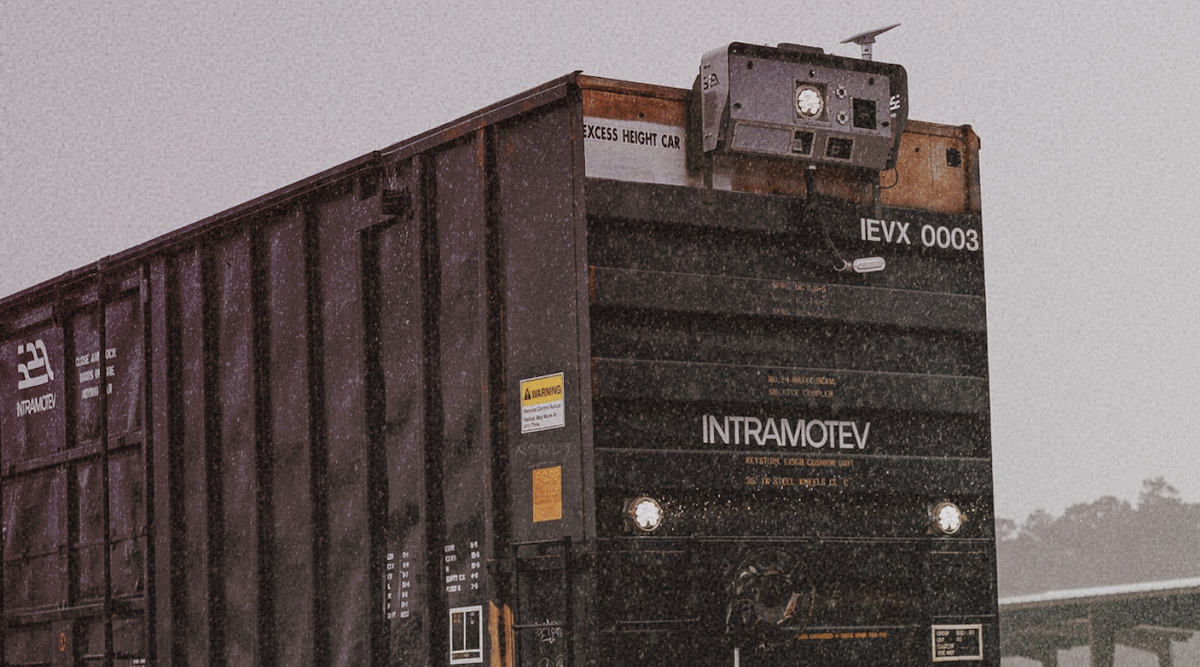
The ill-fated Tesla Cybertruck has been roundly excoriated for its dumpster-adjacent profile, but it looks pretty good compared to the EVs rolling out of the shop at the Missouri-based startup Intramotev. However, looks are not everything. Intramotev is on a mission to chase diesel fuel off the nation’s nation’s rail freight system, and its “TugVolt” autonomous electrified freight cars get the job done, aesthetically pleasing or not.
EVs On Rails, What A Concept
Intramotev surfaced on the CleanTechnica radar back in 2023 with two retrofit products. One is the ReVolt, a battery pack that can be slotted onto existing railcars hauled behind a locomotive, with the aim of saving diesel fuel. The other, more interesting retrofit is the TugVolt, an autonomous, electrified system that enables railcars to go about the business of hauling freight on their own, without a locomotive.
While the battery packs in each TugVolt have a limited range, that’s more than enough to accomplish a good day’s work including “first mile” loading duties. Once loaded up, they can hitch a ride on locomotives for long-distance travel, then split off to unload.
In addition, a freight yard that hosts a full complement of autonomous railcar EVs would require little, if any, participation from diesel-powered switcher locomotives. In addition to hauling its own freight, each TugVolt can also operate as a switcher, ferrying conventional railcars into position behind a locomotive.
The technology also has significant implications for decarbonizing highway freight as well. The closer an electric railcar can get to its destination, the less need there is for a diesel-fueled truck to pick up the slack. In particular, Intramotev is focusing on captive or short line routes, many of which have seen their rail traffic shrink in the face of competition from the trucking industry.
Intramotev On The Move
Intramotev has been rather busy over the past three years. In one particularly interesting development, in June Intramotev lent a TugVolt to a US Army Reserve Training exercise at the Camp Shelby Joint Forces Training Center in Mississippi, billed as the largest training exercise in the history of the Army Reserve.
“Soldiers, according to Intramotev, trained on and operated the TugVolt system under company supervision throughout the exercise and quickly became proficient with the technology, a detail that matters because military rail operations have traditionally required specialized rail crews, a category of personnel the Army has struggled to maintain at sufficient strength given how infrequently large-scale rail movements occur outside major deployment exercises,” reports the independent news and analysis organization Defence Blog.
As noted by Defence Blog, the exercise went off script when railcars loaded with military supplies arrived at the site. However, with their training freshly in hand, the participants were able to deploy the TugVolt to organize the incoming railcars for unloading.
More EVs For Texas
It’s no surprise to find Intramotev in Texas, too, considering the state’s reputation as a hot EV market. On November 3, the company expanded its ongoing relationship with Watco, a holding company specializing in short line railways.
The new arrangement calls for TugVolt to pull zero emission switcher duty at a to-be-named industrial facility in Seadrift, Texas. As noted by Railway Age, the Texas assignment adds to Intramotev’s EV footprint in the US, which also includes Michigan as well as the Army demonstration in Missouri, and a forthcoming agreement in Kentucky.
Railway Age further notes that in April, Intramotev lent itself to electrification efforts in Austria. That’s a particularly significant development because the client is ÖBB, the national railway of Austria, making it the first deployment of TugVolt technology under regulation, in addition to Intramotev’s first overseas client.
The agreement is also significant considering ÖBB’s sprawling footprint in Europe, consisting of more than 1,000 freight trains ranging across 18 countries every day.
Somebody Missed The EV Memo
Even more significant, at least from a policy perspective, is a $16.3 million grant from the Federal Railroad Administration branch of the US Department of Transportation. US taxpayers will shoulder the bulk of the cost-sharing arrangement, which is designed to model best practices for introducing EVs into the nation’s railway system. The project is hosted by the Columbia Terminal Railroad, a city-owned, 21.4 mile line that links two cities in Missouri, Columbia and Centralia.
“The project will deploy autonomous railcars on the line to produce the first documented safety record for autonomous railcar operation and create a workforce training curriculum,” FRA emphasizes.
“The proposed project was selected for Project Development, Final Design, and Construction and involves research and workforce development activities to conduct a phased autonomous rail technology and short-line infrastructure modernization program,” FRA elaborates, further noting that the EV project “aligns with the selection criteria by improving system and service performance,” with the ultimate goal of enabling freight to run more frequently and, ultimately, autonomously.
Of note, the grant of up to $16 million or so is part of a $2.3 billion railway CRISI modernization package, with CRISI being short for Infrastructure and Safety Improvements. Among other purposes, CSRISI “provides a Federal funding opportunity to “mitigate congestion at both intercity passenger rail and freight rail chokepoints to support more efficient travel and goods movement.”
Citing Intramotev official Don Soffer, the local news organization News Tribune notes that “more than 600 short lines in the U.S. have declined in use in recent decades due to their relative inefficiency.”
“Cross-country hauling is more profitable for companies, whereas short lines require very large hauls to justify the quick trip. The Columbia Terminal Railroad (COLT) does not operate on a set schedule, instead hauling whenever enough goods are collected,” the News Tribune continues.
Given that context, if the CSRISI grant is not a decarbonization program for short line railways and associated highway traffic, I’ll eat my hat. It’s also worth noting that practically the entire locomotive fleet of the US runs on a diesel-electric platform, meaning electric motors powered by an on-board generator. While fossil energy is still in play, the diesel-electric configuration is more energy efficient than sending fleets of diesel trucks onto the nation’s highways.
The nation’s trucking industry has also been wrestling with an ongoing driver shortage, providing further motivation to move more freight onto rails, EVs or not.
Stay tuned for updates on that Missouri project. FRA announced its selection for Project Development, Final Design, and Construction in October, so there are still steps to take before the TugVolt begins running.
Meanwhile, circling back around to that Army demo in June, more likely than not the hookup with the US DoD will not be a one-off. The Army has been notoriously slow to adopt EVs, and last year’s sharp U-turn in federal energy policy did not help. Still, the Army has been sending out EV signals through its use of new “anti-idling” kits for ground vehicles, alongside a new contract with the US branch of the firm Rheinmetall for a fleet of crewless hybrid cargo haulers. Again, looks are not everything…
Photo: The US startup Intramotev has ditched asethetic appeal in favor of an EV model that gets the job done, namely, replacing diesel-powered locomotives with rail cars retrofitted for zero-emission propulsion and autonomous operation (cropped, courtesy of Intramotev).
Sign up for CleanTechnica’s Weekly Substack for Zach and Scott’s in-depth analyses and high level summaries, sign up for our daily newsletter, and follow us on Google News!
Have a tip for CleanTechnica? Want to advertise? Want to suggest a guest for our CleanTech Talk podcast? Contact us here.
Sign up for our daily newsletter for 10–15 new cleantech stories a day. Or sign up for our weekly one on top stories of the week if daily is too frequent.

CleanTechnica uses affiliate links. See our policy here.
CleanTechnica’s Comment Policy